


|
|
|
|
|
|
|
|
|
version 11.3
SVG_Define_linear_gradient (parentSVGObject; id; startColor; endColor{; rotation})  String
| Parameter | Type | Description | |
| parentSVGObject | SVG_Ref | | Reference of parent element |
| id | String | | Name of gradient |
| startColor | String | | Start color |
| endColor | String | | End color |
| rotation | Integer | | Rotation of gradient vector |
| Function result | String |  | Reference of gradient |
Description
The SVG_Define_linear_gradient command sets a new linear gradient in the SVG container designated by parentSVGObject and returns its reference. If parentSVGObject is not an SVG document, an error is generated.
A gradient consists in a continuous progressive color transition from one color to another along a vector. Once specified, gradients are called on a given graphic element, while indicating whether this element must be filled or edged with the gradient called.
The id parameter specifies the name of the gradient. If an element with the same name exists, it will be replaced. This is the name that will be used to call the gradient each time a that a color expression is expected by using the syntax "url(#ID)".
The startColor and endColor parameters specify the colors used to begin and end the gradient.
The optional rotation parameter sets the position and direction of the gradient vector (see example).
Example
Draw 6 solid squares where each uses a linear gradient paint server while varying the rotation and direction of the gradient vector:
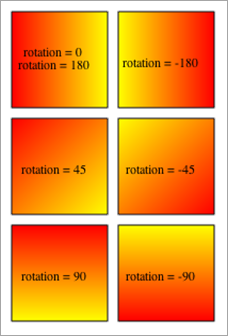
   $svg:=SVG_New

   SVG_Define_linear_gradient ($svg;"demoGradient_1";"red";"yellow")
   SVG_New_rect ($svg;10;10;90;90;0;0;"black";"url(#demoGradient_1)")
   SVG_New_text ($svg;"rotation = 0\rrotation = 180";50;40;"";-1;-1;Center)

   SVG_Define_linear_gradient ($svg;"demoGradient_2";"red";"yellow";180)
   SVG_New_rect ($svg;110;10;90;90;0;0;"black";"url(#demoGradient_2)")
   SVG_New_text ($svg;"rotation = -180";150;50;"";-1;-1; Center)

   SVG_Define_linear_gradient ($svg;"demoGradient_3";"red";"yellow";45)
   SVG_New_rect ($svg;10;110;90;90;0;0;"black";"url(#demoGradient_3)")
   SVG_New_text ($svg;"rotation = 45";50;150;"";-1;-1; Center)

   SVG_Define_linear_gradient ($svg;"demoGradient_4";"red";"yellow";-45)
   SVG_New_rect ($svg;110;110;90;90;0;0;"black";"url(#demoGradient_4)")
   SVG_New_text ($svg;"rotation = -45";150;150;"";-1;-1; Center)

   SVG_Define_linear_gradient ($svg;"demoGradient_5";"red";"yellow";90)
   SVG_New_rect ($svg;10;210;90;90;0;0;"black";"url(#demoGradient_5)")
   SVG_New_text ($svg;"rotation = 90";50;250;"";-1;-1; Center)

   SVG_Define_linear_gradient ($svg;"demoGradient_6";"red";"yellow";-90)
   SVG_New_rect ($svg;110;210;90;90;0;0;"black";"url(#demoGradient_6)")
   SVG_New_text ($svg;"rotation = -90";150;250;"";-1;-1; Center)

      `Save document
   SVG_SAVE_AS_TEXT ($svg;"test.svg")
      `Free up memory
   SVG_CLEAR ($svg)
See Also
SVG Colors, SVG_Define_radial_gradient.
|
|
|
|
|
|
|
|
|